
Resistance Band Workout for Beginners: Full-Body Plan
A full-body resistance band workout for beginners: 8 exercises, how to pick band tension, a 4-week progression plan and safety tips for home training.
Published
A resistance band workout for beginners is one of the easiest ways to start strength training at home: one or two bands, about 30 minutes, and eight exercises that cover your legs, glutes, back, chest, shoulders and core. Below you'll find a complete full-body routine, how to choose the right band tension, a 4-week progression, and the technique tips that make band training safe and effective.
Why resistance bands work so well for beginners
Bands are basically portable weights. They have a few big advantages:
- Low cost and tiny footprint. A set fits in a drawer and travels in a bag.
- Adjustable resistance. Different band strengths, plus how far you stretch them, let you scale every exercise.
- Joint-friendly. Resistance increases gradually as the band stretches, which many people find comfortable.
- Great for pulling exercises. Rows and pulldowns are hard to do with bodyweight alone. Bands solve that.
If you have been doing our home workout plan for beginners, bands are the perfect next step once bodyweight squats and push-ups start to feel easy.
Types of resistance bands
| Band type | What it looks like | Best for |
|---|---|---|
| Mini loop band | Short, flat loop | Glute bridges, lateral walks, clamshells, warm-ups |
| Long loop band | Large continuous loop | Rows, presses, squats, assisted pull-ups |
| Tube band with handles | Tube with handles, often with a door anchor | Presses, rows, curls; feels like cable machines |
| Therapy band (flat, no loop) | Long flat strip | Light rehab-style work, mobility, shoulders |
For this workout, a set of long loop bands or tube bands with handles in a few strengths is ideal. A mini band is a useful extra for glute exercises. If you are deciding what else to buy, check our guide to home gym equipment for beginners.
How to choose the right band tension
Colours and labels vary between manufacturers, so don't rely on colour alone. Use this simple test instead:
- Too light: you could do 25+ reps without effort.
- Right: you can do 10–15 controlled reps and feel you have 2–3 more in the tank.
- Too heavy: your form breaks down before 8 reps, or you have to jerk the band.
Most beginners end up using a lighter band for upper-body exercises (presses, raises, rows) and a heavier band for lower-body exercises (squats, deadlifts, glute bridges). That's completely normal.
You can also fine-tune resistance without changing bands: stand further from the anchor point, or hold the band shorter, to make it harder.
Safety checklist before you start
- Inspect bands before every session. Replace any band with nicks, cracks, sticky patches or thinning spots.
- Anchor bands only to something solid: a closed door with a proper door anchor (pull toward the side that closes the door into its frame), a heavy fixed post, or your own feet.
- Keep the band away from your face when stretching it, and control the return. Don't let it snap back.
- Wear shoes or train on a non-slip surface so the band doesn't slip from under your feet.
- If you have joint problems, an injury, a heart condition or are pregnant, ask your doctor or a physiotherapist before starting.
The 8-exercise full-body resistance band workout
Warm up for 5 minutes first: march on the spot, arm circles, a few slow bodyweight squats, glute bridges and band pull-aparts with a light band. For a longer warm-up, borrow moves from our mobility routine for beginners.
1. Band squat
Stand on the band with feet shoulder-width apart and hold the top of the band at shoulder height. Sit back and down into a squat, keep your chest tall, then stand up. Target: 10–15 reps.
2. Band Romanian deadlift
Stand on the band, holding it with your hands in front of your thighs. With a slight knee bend, push your hips back and lower your hands along your legs until you feel a stretch in your hamstrings, then drive your hips forward to stand up. Keep your back flat. Target: 10–15 reps.
3. Seated or standing band row
Sit with legs straight and loop the band around your feet, or anchor it at chest height in front of you. Pull your elbows back, squeezing your shoulder blades together, then return slowly. Target: 12–15 reps.
4. Band chest press
Anchor the band behind you at chest height, or wrap it around your upper back and hold the ends. Press your hands forward until your arms are straight, then return with control. Target: 10–15 reps.
5. Band glute bridge
Lie on your back, knees bent, with a mini band just above your knees, or a long band held across your hips with your hands pinning it to the floor. Push your hips up, squeeze your glutes, lower slowly. Target: 12–15 reps.
6. Band overhead press
Stand on the band and hold the handles or band ends at shoulder height. Press overhead without arching your lower back, then lower slowly. Use a light band here. Target: 10–12 reps.
7. Band pull-apart
Hold a light band in front of you at shoulder height with straight arms. Pull it apart until it touches your chest, squeezing your shoulder blades. Great for posture. Target: 15–20 reps.
8. Pallof press (core)
Anchor the band at chest height to your side. Stand sideways, hold the band at your chest, and press it straight out in front of you. Resist the band pulling you toward the anchor. Hold 2 seconds, return. Switch sides. Target: 8–10 reps per side.
Workout format
Do the exercises as a circuit: one set of each, rest 1–2 minutes, then repeat. Alternatively, do all sets of one exercise before moving to the next, resting 45–90 seconds between sets. Both work. Circuits save time; straight sets let you focus on technique.
The 4-week resistance band plan
Train 2–3 times a week on non-consecutive days.
| Week | Rounds | Reps | Focus |
|---|---|---|---|
| 1 | 2 | Bottom of the range (e.g. 10) | Learn the movements, find the right bands |
| 2 | 3 | Bottom to middle of the range | Smooth tempo: 2 seconds out, 2 seconds back |
| 3 | 3 | Top of the range (e.g. 15) | Add a 1-second pause at the hardest point |
| 4 | 3–4 | Top of the range | Move to a stronger band on 1–2 exercises |
Sample week
| Day | Session |
|---|---|
| Monday | Band workout |
| Tuesday | Walk or easy cardio |
| Wednesday | Band workout |
| Thursday | Rest or mobility |
| Friday | Band workout |
| Weekend | Active rest: walk, bike, play a sport |
Need help deciding how much recovery to plan? Read how many rest days a week you really need.
How to progress with bands
Progression is what turns a workout into a training plan. Once all sets at the top of the rep range feel controlled, make it harder using one of these levers:
- Use a stronger band.
- Shorten the band or stand further from the anchor point.
- Slow the tempo, especially on the return (3–4 seconds).
- Add pauses at full stretch.
- Add a round or a few reps.
- Combine bands for more tension, if they're designed for it.
The same principle applies to every kind of strength training, whether you use bands, dumbbells or a barbell. Our strength training for beginners guide explains it in more depth.
Common mistakes with resistance band workouts
- Letting the band snap back. The return phase is half the exercise. Control it.
- Using too much tension too early. If your shoulders shrug or your back arches, go lighter.
- Shrugging during rows and presses. Keep your shoulders down and away from your ears.
- Poor anchoring. A slipping anchor is a safety risk. Double-check before each set.
- Only training the front of the body. Rows, pull-aparts and deadlifts balance out pressing movements.
- Forgetting recovery and food. To build strength, your body needs enough protein and energy. Our article on how much protein per day gives practical, commonly cited ranges.
Band workout checklist
- Long bands (2–3 strengths) and optionally a mini band
- Door anchor or a solid fixed anchor point
- Bands inspected for damage
- 5-minute warm-up done
- 8 exercises, 2–3 rounds
- Reps logged, so you know when to progress
- At least one rest day between sessions
The bottom line
A resistance band workout for beginners gives you a complete, full-body strength routine for very little money and space. Choose bands that allow 10–15 controlled reps, train two or three times a week, and progress steadily by using stronger bands, slower tempo or more reps. Stay safe by checking your bands and anchors every time, and talk to a healthcare professional if you have any medical concerns before starting a new programme.
FAQ
Are resistance bands good for beginners?
Yes. Bands are light, cheap and adjustable, and they let you train every major muscle group at home. They are also gentle on joints because the resistance builds up smoothly.
Which resistance band should a beginner start with?
Start with a light to medium band that lets you complete 12 to 15 controlled reps with good form. Most people need a lighter band for upper-body moves and a heavier one for legs and glutes.
How often should I do a resistance band workout?
Two to three full-body sessions a week on non-consecutive days is a good starting point. That leaves time for recovery between sessions.
Can you build muscle with resistance bands?
Beginners can build strength and muscle with bands, especially when they progress by using stronger bands, more reps or slower tempo. Very advanced lifters may eventually need heavier external loads.
From the shop
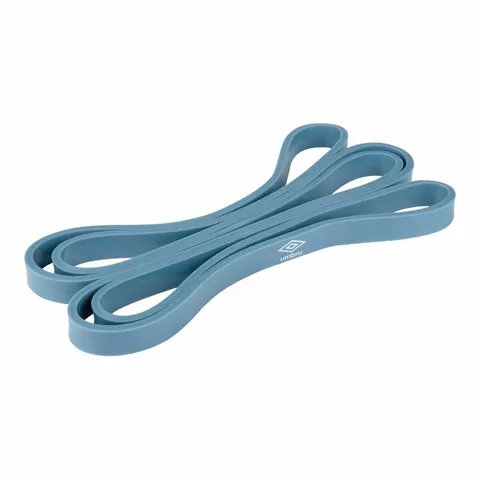
Umbro power band 15 kg, blue
A long 208 cm loop band from Umbro with a 15 kg resistance rating for full-body strength work and assisted pull-ups.
Price: €8.99incl. VAT, plus shipping
Not available
Related articles
Home workouts
Home Gym Equipment for Beginners: What to Buy First
Which home gym equipment beginners actually need, what to buy first, what to skip, and how to set up a small, safe training corner on any budget.
8min read
Home workouts
Home Workout Plan for Beginners (No Equipment Needed)
A simple 4-week home workout plan for beginners with no equipment: three short sessions a week, clear progressions, and tips to stay consistent.
9min read
Strength training
Warm-Up Sets: How Many to Do and What Weight to Use
How many warm-up sets to do before lifting, what weight and reps to use, and how long to rest, with a simple template and two worked examples in kg.
8min read