
Strength Training for Beginners: The Complete Starter Guide
Strength training for beginners made simple: the key lifts, how many sets and reps, how often to train, how to progress and a 12-week starter plan.
Published
Strength training for beginners comes down to a few simple rules: train your whole body two or three times a week, focus on a handful of basic movement patterns (squat, hinge, push, pull, carry), use a weight you can control for 6–12 reps, and add a little load or a rep whenever the last session felt manageable. That is it. Everything else, from fancy splits to supplements, is fine-tuning you can worry about much later.
This guide walks you through the essentials: what to train, how much, how often, how to progress, and a complete 12-week plan you can start this week. If you are brand new and nervous about the gym floor, good news: the beginner phase is the most rewarding part. You get stronger almost every week.
Before you start: if you have a heart condition, high blood pressure, joint problems, a past injury, are pregnant or simply have not exercised in a long time, check in with your doctor or a qualified physiotherapist first. Sharp pain is a stop signal, not something to push through.
Why strength training is worth your time
Lifting is not only for bodybuilders. Getting stronger makes everyday life easier: carrying groceries, lifting a suitcase into an overhead bin, playing with kids, getting up off the floor. Strength work is also widely recommended by public health guidelines alongside cardio, and it pairs well with running or cycling because stronger muscles and tendons handle repetitive impact better.
It is also very measurable. Unlike some fitness goals, you can see your progress in your training log: 20 kg became 25 kg, 8 reps became 10 reps. That feedback loop is a great motivator.
The five movement patterns that matter
Forget memorising hundreds of exercises. Almost every useful strength exercise falls into one of five patterns. Train each one and you have covered your whole body.
| Pattern | What it trains | Beginner options | Gym options |
|---|---|---|---|
| Squat | Thighs, glutes, core | Bodyweight squat, goblet squat | Back squat, leg press |
| Hinge | Hamstrings, glutes, back | Glute bridge, hip hinge with a dowel | Romanian deadlift, deadlift |
| Push | Chest, shoulders, triceps | Incline push-up, push-up | Bench press, overhead press |
| Pull | Upper back, biceps | Band row, table row | Lat pulldown, dumbbell row |
| Carry / core | Grip, trunk stability | Plank, dead bug | Farmer's carry, Pallof press |
Start with the simplest version of each pattern that you can do with clean technique. A goblet squat (holding one dumbbell at your chest) is often easier to learn than a barbell back squat, and it still builds real strength.
Sets, reps and rest: the beginner sweet spot
Here is a simple rule of thumb that works for most beginners:
- Sets: 2–3 working sets per exercise
- Reps: 6–12 reps per set for most exercises (8–15 for small muscles or bodyweight moves)
- Effort: stop each set with about 2–3 reps still "in the tank"
- Rest: 1–2 minutes between sets for most exercises, up to 3 minutes for heavy squats or deadlifts
That "reps in the tank" idea is important. You do not need to grind every set to failure. Training slightly short of failure keeps your technique clean, reduces soreness and still gives your muscles a strong signal to adapt. If you want to understand how to rate effort precisely, our guide to progressive overload explains the RPE and RIR scales.
How often to train
For beginners, full-body training two or three times per week beats a "chest day, leg day, arm day" split. You practise each movement more often, which helps you learn faster, and missing one session does not mean a muscle group goes untrained for two weeks.
| Schedule | Example | Good for |
|---|---|---|
| 2 days per week | Monday, Thursday | Busy schedules, combining with running |
| 3 days per week | Monday, Wednesday, Friday | Most beginners, fastest progress |
| 4 days per week | Upper/lower split | After 3–6 months of consistent training |
Leave at least one day between sessions that train the same muscles. Recovery is when the adaptation happens. Not sure how much rest you need? Read how many rest days a week you should take.
If you want a ready-made session layout, our 3 day full body workout for beginners gives you exact exercises, sets and reps for each day.
How to choose your starting weights
This is where most beginners either go too heavy (and hurt their form) or too light (and never progress). Use this simple test for each exercise:
- Warm up with an empty bar, very light dumbbells or just your bodyweight for 10 reps.
- Add a small amount of weight and do 8 reps.
- Keep adding small jumps until 8 reps feels like you could do 2–3 more with good form.
- That is your starting working weight. Write it down.
Starting a little too light is not a problem. You will move up quickly in the first weeks, and those easy early sessions give you time to perfect your technique.
Later, once you have some experience, you might want a rough idea of your maximum strength to plan percentages. Testing a true one-rep max is not necessary or recommended for beginners. Instead, you can estimate it from a set of several reps with our one rep max calculator, and our guide on how to calculate one rep max explains the formulas and their limits.
Progression: how you actually get stronger
Your body adapts to the demands you place on it. If those demands never change, your progress stalls. The fix is called progressive overload: gradually doing a bit more over time.
The simplest method for beginners is double progression:
- Choose a rep range, for example 8–12.
- Start with a weight you can lift for 8 reps.
- Each session, try to add a rep to one or more sets.
- When you hit 12 reps on all sets with good form, increase the weight by the smallest jump available (often 1–2.5 kg for upper body, 2.5–5 kg for lower body).
- Drop back to 8 reps with the new weight and build up again.
Worked example: goblet squat with a 16 kg dumbbell, 3 sets.
| Session | Weight | Reps per set |
|---|---|---|
| 1 | 16 kg | 8, 8, 8 |
| 2 | 16 kg | 10, 9, 8 |
| 3 | 16 kg | 11, 10, 10 |
| 4 | 16 kg | 12, 12, 11 |
| 5 | 16 kg | 12, 12, 12 |
| 6 | 20 kg | 8, 8, 7 |
That is all progression is: small, steady steps. For deeper detail on all the ways to progress (reps, sets, load, tempo), read progressive overload explained.
A 12-week strength training plan for beginners
This plan uses two alternating workouts, A and B, three times a week. Week 1 might be A–B–A, week 2 B–A–B, and so on.
Workout A
| Exercise | Sets × reps |
|---|---|
| Goblet squat | 3 × 8–12 |
| Dumbbell bench press or push-up | 3 × 8–12 |
| One-arm dumbbell row | 3 × 8–12 per side |
| Glute bridge | 2 × 10–15 |
| Plank | 3 × 20–40 seconds |
Workout B
| Exercise | Sets × reps |
|---|---|
| Romanian deadlift (dumbbells) | 3 × 8–12 |
| Split squat | 2 × 8–10 per side |
| Overhead press (dumbbells) | 3 × 8–12 |
| Lat pulldown or band pulldown | 3 × 10–12 |
| Farmer's carry | 3 × 30–40 metres |
The 12-week roadmap
| Weeks | Focus | What to do |
|---|---|---|
| 1–2 | Learn the movements | 2 sets per exercise, light weights, film yourself or use a mirror |
| 3–6 | Build the habit | 3 sets, apply double progression every session |
| 7–10 | Push steadily | Keep adding reps and weight, log everything |
| 11 | Lighter week | Cut sets in half, keep the same weights, focus on technique |
| 12 | Review | Compare your log to week 3 and set new targets |
If you would rather train at home with no equipment, our home workout plan for beginners follows the same principles with bodyweight exercises.
Warm-up routine (5–8 minutes)
You do not need a 30-minute warm-up. Something like this does the job:
- 3–5 minutes of easy cardio (brisk walk, bike, rowing machine, skipping)
- 10 bodyweight squats
- 10 glute bridges
- 10 arm circles each direction
- 1–2 lighter warm-up sets of your first exercise
For a routine that also improves your range of motion over time, have a look at our mobility routine for beginners.
Common beginner mistakes
- Adding weight too quickly. If your form breaks down, the weight is too heavy. Ego lifting is the fastest route to a setback.
- Program hopping. Switching plans every week means you never progress on anything. Stick with one plan for at least 8–12 weeks.
- Skipping the log. If you do not write down weights and reps, you cannot apply progressive overload. A notes app works fine.
- Training to failure every set. It makes you very sore and slows recovery. Leave a couple of reps in reserve.
- Neglecting pulling exercises. Many beginners do lots of pushing (push-ups, bench press) and little pulling. Aim for roughly equal amounts.
- Ignoring sleep and food. Training is the stimulus, but recovery builds the muscle. Our article on how much protein per day covers the nutrition side.
Beginner strength training checklist
- I train 2–3 times per week with a rest day in between
- Every session covers squat, hinge, push, pull and core or carry
- I do 2–3 sets of 6–12 reps and stop with 2–3 reps in reserve
- I log every session (exercise, weight, reps)
- I add a rep or a small amount of weight when the target is reached
- I warm up for 5–8 minutes
- I sleep enough and eat enough protein
- I stop and seek professional advice if I feel sharp or lasting pain
Making it stick
The best plan is the one you actually follow. Schedule your sessions like appointments, keep your gym bag packed and start small if motivation is shaky. Two short sessions a week that you never miss beat five ambitious ones you abandon after a fortnight. If consistency is your weak spot, our guide on how to build a workout habit has practical tactics.
Strength training rewards patience. Learn the basic patterns, progress a little at a time and keep showing up. A few months from now, the weights that feel heavy today will be your warm-up sets.
FAQ
How often should a beginner do strength training?
Two to three full-body sessions per week with at least one rest day in between is a solid starting point for most beginners. That is enough practice to learn the movements and enough rest to recover.
How heavy should I lift as a beginner?
Pick a weight you can lift for the target reps with good form while leaving about two or three reps in reserve. If the last rep looks like the first, it is probably time to add a little weight next session.
Do I need a gym to start strength training?
No. Bodyweight exercises, resistance bands and a pair of dumbbells are enough to build a strong base. A gym makes it easier to keep adding load over the long term, but it is not required to begin.
How long until I see results from strength training?
Most beginners notice that weights feel easier within the first few weeks, largely because their technique and coordination improve. Visible changes in muscle take longer and depend on consistency, sleep and nutrition.
From the shop
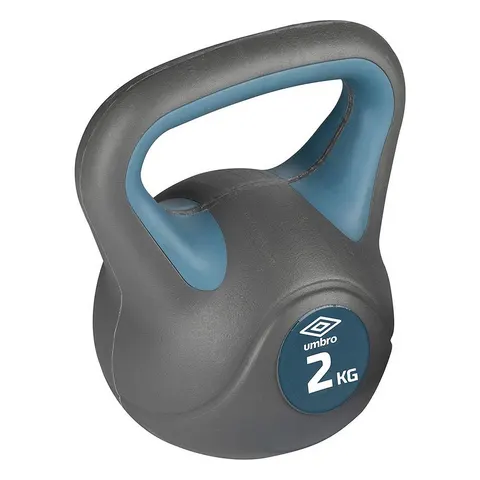
Umbro kettlebell 2 kg, grey/blue
A light 2 kg composite kettlebell from Umbro for warm-ups, shoulder drills and learning kettlebell basics at home.
Price: €7.99incl. VAT, plus shipping
Not available
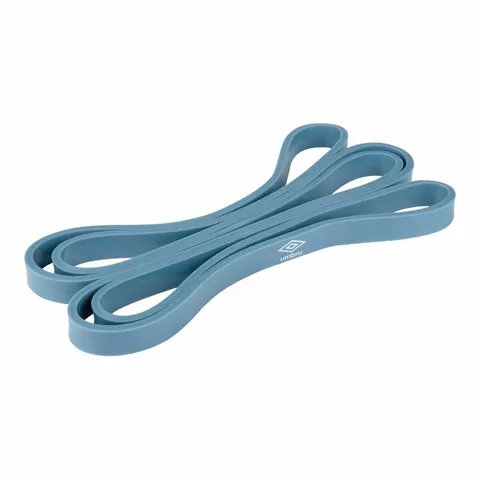
Umbro power band 15 kg, blue
A long 208 cm loop band from Umbro with a 15 kg resistance rating for full-body strength work and assisted pull-ups.
Price: €8.99incl. VAT, plus shipping
Not available
Related articles
Strength training
3 Day Full Body Workout for Beginners (Free Plan)
A 3 day full body workout for beginners with exact exercises, sets, reps and rest times, plus a weekly schedule, swaps for home and an 8-week progression.
8min read
Strength training
Progressive Overload Explained: How to Keep Getting Stronger
Progressive overload explained for beginners: six ways to progress, how to use RPE and reps in reserve, worked examples and a simple plan to avoid plateaus.
8min read
Strength training
Warm-Up Sets: How Many to Do and What Weight to Use
How many warm-up sets to do before lifting, what weight and reps to use, and how long to rest, with a simple template and two worked examples in kg.
8min read